

Table of Contents
ToggleDigital Marketing Services for Small Business: Complete Guide
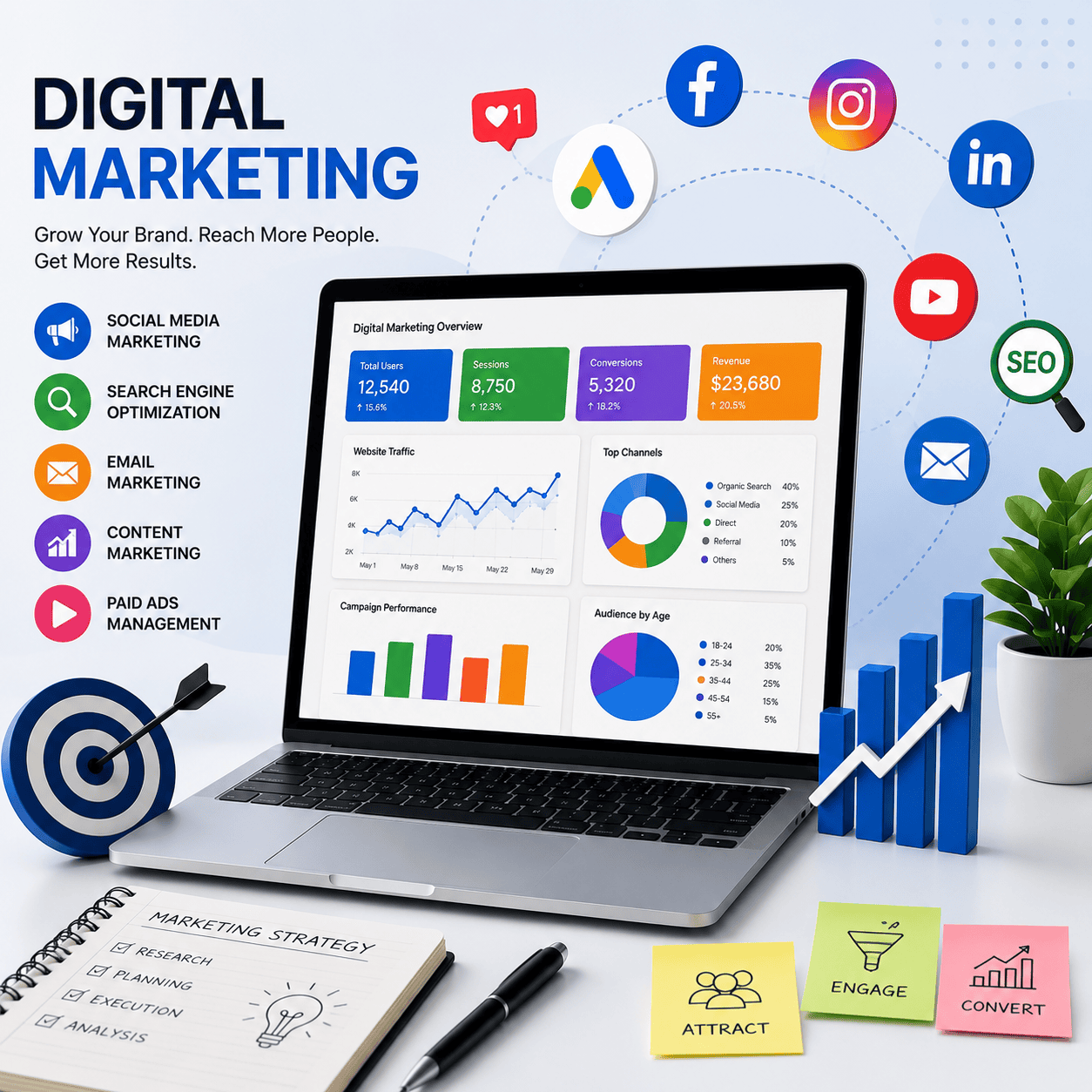
Running a small business today is very different from running one a few years ago. Customers now search on Google, check social media, read reviews, compare prices, and visit websites before deciding whether to contact a business. Because of this change in customer behaviour, having an online presence is no longer optional for most businesses. This is where digital marketing services for small business can make a significant difference. Digital marketing allows small businesses to reach potential customers online, build brand awareness, generate leads, increase website traffic, and turn visitors into paying customers. Unlike traditional advertising, digital marketing also provides measurable data that can help businesses understand what is working and where their marketing budget is being spent. In this guide, we will explain the most important digital marketing services for small businesses, how they work, why they matter, and how you can create an effective digital marketing strategy for your business. For many local and online businesses, digital marketing services for small business provide a way to reach potential customers without relying only on traditional advertising.
What Are Digital Marketing Services for Small Business?
Digital marketing services are online marketing activities that help a business attract, engage, and convert potential customers.
For a small business, these services can include:
- Search Engine Optimization (SEO)
- Local SEO
- Google Ads and Pay-Per-Click advertising
- Social media marketing
- Content marketing
- Email marketing
- Website development and optimization
- Google Business Profile optimization
- Online reputation management
- Conversion tracking and analytics
The right combination depends on your business type, target audience, location, competition, and marketing goals.
For example, a local driving school may benefit heavily from local SEO and Google Ads, while an online education business may focus more on SEO, content marketing, social media, and paid advertising.
Why Is Digital Marketing Important for Small Businesses?
Small businesses often compete with larger companies that have bigger advertising budgets. Digital marketing can help smaller businesses compete by allowing them to target specific audiences instead of advertising to everyone.
Here are some of the major benefits.
1. Reach Customers Where They Search
People use search engines every day to find products and services.
Someone might search for:
- web development company near me
- digital marketing agency in India
- best driving school near me
- Google Ads services for small business
- SEO services for local businesses
If your business appears when someone is actively searching for your service, you have an opportunity to attract a highly relevant customer.
2. Build Online Visibility
A business website alone does not automatically guarantee visitors.
Your business needs visibility through search engines, social media, local listings, advertising, and useful content.
A well-planned digital marketing strategy can help your business appear in multiple places where potential customers spend their time online.
3. Generate More Qualified Leads
Digital marketing allows businesses to target people based on factors such as:
- Search queries
- Location
- Interests
- Demographics
- Online behaviour
- Previous interactions with your business
This can make your marketing more targeted than traditional advertising.
4. Measure Your Results
One of the biggest advantages of online marketing is measurement.
You can track metrics such as:
- Website visitors
- Leads
- Phone calls
- Form submissions
- Clicks
- Conversion rate
- Cost per lead
- Advertising spends
- Search rankings
- Engagement
This information can help you understand which marketing activities are producing useful results.
10 Essential Digital Marketing Services for Small Business
There is no single marketing channel that works for every business. However, the following services are commonly useful for small businesses.
1. Search Engine Optimization (SEO)
SEO is the process of improving a website so that search engines can better understand its content and users can discover it through organic search results.
For example, suppose you own a web development business and want to attract customers searching for website development services.
You could create useful pages targeting relevant topics such as:
- Website development services
- Business website development
- WordPress website development
- Website development for small businesses
SEO generally takes time because search visibility develops through content quality, technical improvements, relevance, authority, and other factors.
Important areas of SEO include:
- Keyword research
- Search intent
- On-page SEO
- Technical SEO
- Internal linking
- Website structure
- Helpful content
- Mobile usability
- Page experience
- Local SEO
- Backlinks and mentions
SEO can be particularly useful for businesses that want to generate organic traffic over the long term.
2. Local SEO
SEO is one of the most important digital marketing services for small business because it can help a website attract relevant organic search traffic.
Local SEO is especially important for businesses that serve customers in specific geographic areas.
Examples include:
- Restaurants
- Gyms
- Driving schools
- Salons
- Dentists
- Real estate businesses
- Local service providers
- Digital marketing agencies
- Repair services
When people search for a local service, search engines may show local business information and map results.
A local SEO strategy can include:
- Optimizing your Google Business Profile
- Keeping business information accurate
- Using relevant local keywords
- Collecting genuine customer reviews
- Creating location-specific website content
- Building relevant local citations
- Improving local landing pages
The right digital marketing services for small business should be selected according to your audience, industry, location and marketing goals.
For example, instead of targeting only “digital marketing services,” a business serving a specific area could create relevant content around searches such as “digital marketing services in Ludhiana.”
The goal should be to provide useful local information rather than simply repeating a city name throughout a page.
3. Google Ads and Pay-Per-Click Advertising
Digital marketing services for small business can also include paid advertising such as Google Ads when immediate search visibility is an important business goal.
Google Ads allows businesses to advertise across Google’s advertising network, including search results and other eligible placements.
For small businesses, Search campaigns can be useful when customers are actively searching for products or services.
For example:
Search:
“website development company near me”
A business offering website development could create an ad relevant to that search.
Google Ads can help businesses reach potential customers without waiting for organic rankings to develop.
However, paid advertising requires careful management.
Important areas include:
- Keyword selection
- Search intent
- Match types
- Negative keywords
- Ad copy
- Landing pages
- Location targeting
- Budget management
- Conversion tracking
- Bid strategy
- Performance analysis
The goal should not simply be to generate clicks. Businesses should focus on meaningful actions such as leads, calls, purchases, bookings, or other conversions relevant to their objectives.
4. Social Media Marketing
Social media can help small businesses build awareness and maintain relationships with their audience.
Depending on the target audience, a business may use platforms such as:
- YouTube
- Other relevant social platforms
Social media content can include:
- Educational posts
- Product demonstrations
- Customer stories
- Short videos
- Behind-the-scenes content
- Industry tips
- Frequently asked questions
- Offers and announcements
The most effective platform depends on where your target customers actually spend their time.
A small business does not necessarily need to be active on every platform. It is often more practical to consistently create useful content for the platforms that matter most to its audience.
5. Content Marketing
Content marketing involves creating useful information that helps your target audience solve problems or make decisions.
Examples include:
- Blog posts
- Guides
- Tutorials
- Case studies
- Videos
- Infographics
- FAQs
- Checklists
For example, a digital marketing company could publish articles such as:
- How to Improve Your Google Ranking
- Digital Marketing Services for Small Business
- How Google Ads Works
- SEO vs Google Ads
- How to Choose a Digital Marketing Agency
Content marketing can support SEO while also helping potential customers understand your expertise.
The most important principle is to create content for people first. Content should answer the user’s question clearly instead of being written only to insert keywords.
6. Website Development and Optimization
Your website is often the central part of your digital marketing system.
You can drive thousands of visitors to a website, but if the website is difficult to use, slow, confusing, or poorly structured, visitors may leave without contacting you.
A business website should generally have:
- Clear navigation
- Mobile-friendly design
- Fast-loading pages
- Clear service information
- Strong calls to action
- Contact information
- Easy-to-use forms
- Trust signals
- Relevant images
- Helpful content
Important pages may include:
- Home
- About Us
- Services
- Individual service pages
- Portfolio or case studies
- Blog
- Contact
- Privacy Policy
Your website should make it easy for visitors to understand three things:
What do you offer?
Who do you help?
How can they contact you?
7. Google Business Profile
For eligible local businesses, a Google Business Profile can be an important part of local online visibility.
A properly maintained profile can provide potential customers with information such as:
- Business name
- Address or service area
- Phone number
- Website
- Opening hours
- Photos
- Reviews
- Services
Businesses should keep their information accurate and up to date.
Customer reviews are also important because people often use reviews when evaluating local businesses.
Businesses should focus on providing good service and encouraging genuine customers to leave honest reviews rather than using misleading or artificial review practices.
8. Email Marketing
Email marketing allows businesses to communicate directly with people who have chosen to receive their emails.
It can be used for:
- Newsletters
- New product announcements
- Offers
- Educational content
- Follow-ups
- Customer updates
- Lead nurturing
For example, someone may download a useful guide from your website and voluntarily provide their email address. With appropriate permission and compliant practices, the business can use email marketing to continue providing useful information.
Email marketing is particularly useful when customers need time before making a purchase decision.
9. Online Reputation Management
Before contacting a business, potential customers may search for its reviews and online reputation.
Reputation management involves monitoring and responding appropriately to customer feedback across relevant platforms.
A good reputation strategy includes:
- Providing quality customer service
- Monitoring reviews
- Responding professionally
- Addressing genuine complaints
- Encouraging legitimate customers to share feedback
- Keeping business information accurate
The goal should be to build trust through real customer experiences rather than trying to manipulate ratings.
10. Analytics and Conversion Tracking
Marketing decisions should be based on data whenever possible.
Analytics tools can help businesses understand:
- Where visitors come from
- Which pages they visit
- How long they engage with content
- Which marketing channels generate conversions
- Which campaigns generate leads
- Where users leave the website
Conversion tracking is particularly important for paid advertising.
For example, if a business spends money on Google Ads, it should ideally know whether those clicks resulted in:
- Form submissions
- Phone calls
- Purchases
- Bookings
- Sign-ups
Without conversion tracking, it can be difficult to understand the actual business impact of advertising.
SEO vs Google Ads: Which Should a Small Business Use?
SEO and Google Ads work differently.
SEO focuses on earning organic visibility in search results.
Google Ads uses paid advertising to reach eligible audiences through Google’s advertising platforms.
SEO can take time to develop, while paid advertising can provide visibility once campaigns are active and approved.
For many businesses, the two strategies can complement each other.
For example:
SEO: Build long-term organic visibility.
Google Ads: Reach relevant searches through paid advertising.
A business does not necessarily have to choose only one. The appropriate combination depends on budget, competition, business goals, customer journey, and available resources.
How Digital Marketing Services for Small Business Can Generate Leads?
A well-planned digital marketing services for small business strategy can combine SEO, Google Ads, content marketing and social media.
How to Create a Digital Marketing Strategy for a Small Business
Before spending money on marketing, define your strategy.
Step 1: Define Your Target Audience
Identify:
- Who are your customers?
- Where are they located?
- What problems do they have?
- What services do they need?
- What questions do they search online?
- What factors influence their purchase decision?
Step 2: Set Clear Goals
Instead of saying “I want more online visibility,” create measurable objectives.
Examples include:
- Increase qualified website traffic
- Generate more inquiries
- Increase phone calls
- Increase online bookings
- Improve organic visibility
- Generate more sales
Step 3: Research Keywords
Find keywords that your potential customers actually use.
Consider:
- Search intent
- Relevance
- Competition
- Location
- Commercial intent
- Long-tail keywords
Do not select keywords simply because they have high search volume. A smaller keyword with strong purchase intent can sometimes be more relevant to a business.
Step 4: Optimize Your Website
Make sure your website clearly communicates:
- Your services
- Your target audience
- Your location
- Your unique value
- How customers can contact you
Step 5: Select the Right Marketing Channels
You do not need to use every channel immediately.
Depending on your business, you might begin with:
Local business: Local SEO + Google Business Profile + Google Ads
B2B business: SEO + LinkedIn + content marketing
E-commerce business: SEO + Google Ads + social media
Professional service business: SEO + Google Ads + content marketing
Step 6: Track Performance
Monitor meaningful metrics regularly.
For example:
- Leads
- Sales
- Conversion rate
- Cost per lead
- Organic traffic
- Search visibility
- Ad performance
- Website engagement
Then use the data to improve your strategy.
How Much Do Digital Marketing Services Cost for a Small Business?
There is no single price for digital marketing.
The cost depends on factors such as:
- Number of services
- Business location
- Competition
- Advertising budget
- Website size
- Content requirements
- SEO requirements
- Campaign complexity
- Agency or freelancer fees
It is also important to separate marketing service fees from advertising spend.
For example, if a business hires someone to manage Google Ads, the management fee and the actual Google Ads budget are generally two different costs.
Small businesses should evaluate marketing based on business objectives and measurable results rather than selecting a provider solely because they offer the cheapest package.
Common Digital Marketing Mistakes Small Businesses Should Avoid
- Trying Every Platform at Once
Being everywhere is not always better.
Focus on the channels where your potential customers are most likely to be.
- Targeting Too Many Keywords
A website cannot realistically target every keyword.
Focus on relevant keywords that match your products, services, audience, and search intent.
- Ignoring Local SEO
If you serve a specific geographic area, local search visibility can be important.
- Running Ads Without Conversion Tracking
Clicks alone do not tell you whether advertising is generating business results.
- Having a Poor Landing Page
An advertisement can attract a visitor, but the landing page needs to clearly explain the offer and provide an easy next step.
- Publishing Content Without Understanding Search Intent
A blog should answer the question behind the search.
If someone searches “how much does website development cost,” an article that only promotes your services may not satisfy the user’s intent.
- Expecting Immediate SEO Results
SEO generally requires consistent effort and time. Businesses should avoid expecting guaranteed rankings within a few days.
- Ignoring Mobile Users
A significant amount of internet activity happens on mobile devices, so websites should be easy to navigate on smaller screens.
How to Measure Digital Marketing Success
The right metrics depend on your goal.
If your goal is website traffic:
Track:
- Organic traffic
- Paid traffic
- Referral traffic
- Search visibility
If your goal is lead generation:
Track:
- Leads
- Form submissions
- Phone calls
- Conversion rate
- Cost per lead
If your goal is sales:
Track:
- Purchases
- Revenue
- Conversion rate
- Customer acquisition cost
- Return on advertising spend where appropriate
Avoid focusing only on vanity metrics such as likes or impressions if your actual business goal is generating customers.
Why Choose Digital Marketing Services for Small Business?
Choosing the right digital marketing services for small business depends on your target audience, budget, industry and business goals.
Digital Marketing Checklist for Small Businesses
Before launching your marketing strategy, check the following:
- Professional website
- Mobile-friendly website
- Clear service pages
- Contact form
- Click-to-call option where relevant
- Google Business Profile
- Accurate business information
- Keyword research
- SEO-friendly website structure
- Useful blog content
- Google Analytics or appropriate analytics setup
- Conversion tracking
- Google Ads strategy if paid advertising is suitable
- Social media profiles where relevant
- Customer review strategy
- Clear calls to action
- Regular performance analysis
Frequently Asked Questions
What are the most important digital marketing services for small businesses?
The right digital marketing services for small business can help you build online visibility and connect with potential customers.
Is digital marketing worth it for a small business?
Digital marketing can help a small business reach potential customers online, generate leads, build visibility, and measure marketing activity. The effectiveness depends on the strategy, execution, market, competition, and business offer.
How long does SEO take for a small business?
SEO does not have a fixed timeline. Results can depend on competition, website condition, content quality, authority, search demand, and the work being implemented. Businesses should generally approach SEO as an ongoing process rather than expecting immediate results.
Should a small business use Google Ads?
Google Ads can be useful when there is relevant search demand and the business can convert that traffic into valuable actions. Proper targeting, ad copy, landing pages, budget management, and conversion tracking are important.
What is the difference between SEO and digital marketing?
SEO is one part of digital marketing. Digital marketing includes a much broader range of activities, such as SEO, paid advertising, social media, email marketing, content marketing, websites, and analytics.
Can a small business do digital marketing itself?
Yes. Many small businesses can handle basic digital marketing activities internally. However, more technical areas such as advanced SEO, paid advertising, conversion tracking, website development, and campaign optimization may require specialized knowledge.
How can I choose digital marketing services for my small business?
Start by identifying your business goals, target audience, location, budget, and customer journey. Then select the marketing channels that align with those goals instead of paying for services that your business does not need.
Final Thoughts
Digital marketing can give small businesses a practical way to reach customers, build online visibility, generate leads, and measure marketing performance.
However, successful digital marketing is not simply about being present on every platform or spending more money on advertising. It starts with understanding your customers and choosing the right channels for your business.
For some businesses, SEO and local SEO may be central to their strategy. Others may benefit from Google Ads, social media marketing, content marketing, or email marketing. In many cases, a combination of channels can work together to support different stages of the customer journey.
The most important approach is to start with clear goals, create useful content and experiences for your audience, track meaningful results, and continuously improve your strategy based on reliable data.
If you are a small business owner looking to improve your online presence, investing in the right digital marketing services for small business can help you build a stronger foundation for long-term online growth.
Pingback: Google Ads for Small Business: The Ultimate 2026 Guide
Pingback: How to Improve Ranking on Google: Complete SEO Guide 2026